
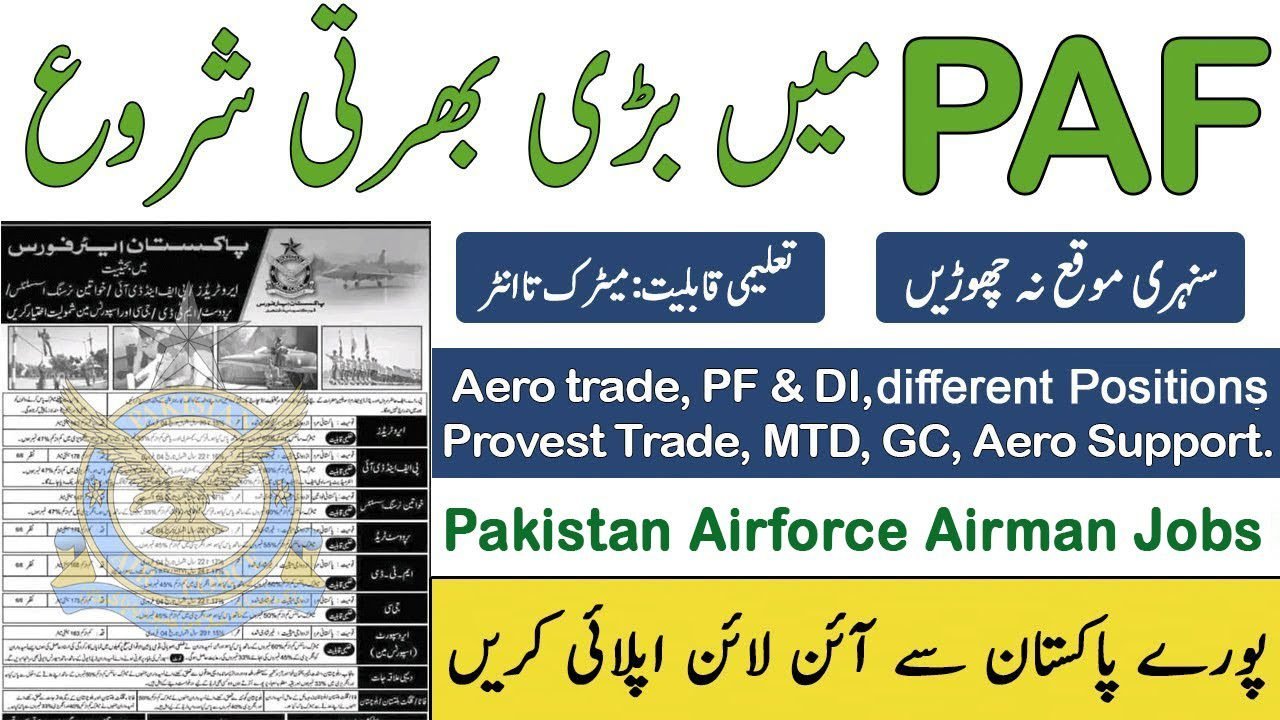
کیا آپ کا خواب نیلگوں آسمانوں کو چھوتے ہوئے ہوائی جہازوں کا محافظ بننے کا ہے؟ کیا آپ کی رگوں میں وہ ولولہ ہے جو پاکستان کی فضائی سرحدوں کی حفاظت کے لیے اڑان بھرنے کو تیار ہو؟ اگر ہاں، تو پاک فضائیہ میں 2026 کے لیے بھرتیوں کا اعلان آپ کے لیے ایک بہترین موقع ہے۔ یہ محض نوکری نہیں، بلکہ ایک اعزاز ہے، ایک مقدس فریضہ ہے جہاں آپ کی اڑان قومی سلامتی کی ضمانت بنتی ہے۔
تصور کیجیے کہ آپ ایک ایف 16 یا جے ایف 17 تھنڈر کا پائلٹ ہوں، آپ کے ہاتھ میں ملک کی فضائی سلامتی کی باگ ڈور ہو، یا آپ جدید ترین ہوائی جہازوں کی دیکھ بھال اور انجینئرنگ کرنے والی ٹیم کا حصہ ہوں۔ پاک فضائیہ نہ صرف پائلٹوں کے لیے، بلکہ ایئر ڈیفنس آفیسرز، ایئرو اسپیس انجینئرز، ایئرٹرافک کنٹرولرز، ٹیکنیشنز، اور انتظامی افسروں کے لیے بھی وسیع مواقع فراہم کرتی ہے۔ یہ ادارہ قوم کی آنکھ کا تارا ہے۔
کیا آپ اس باعزت اور چیلنجنگ پیشے کے لیے تیار ہیں؟ کیا آپ میں وہ ذہنی استقامت، جسمانی قوت، اور قومی جذبہ موجود ہے جو پاک فضائیہ کے جوان کی پہچان ہے؟ ذیل کی جدول میں ہم نے پی اے ایف میں کیریئر کے بنیادی راستوں کی جھلک پیش کی ہے۔ اسے پڑھیں، اپنی صلاحیتوں کا جائزہ لیں، اور پاک فضائیہ کا حصہ بننے کا فیصلہ کریں۔
| تفصیل | معلومات کا خلاصہ |
|---|---|
| بھرتی کرنے والا ادارہ | پاک فضائیہ (پی اے ایف) |
| اہم بھرتی کی اقسام | جنرل ڈیوٹی پائلٹ (GDP)، ایئرو اسپیس انجینئر، ایئر ڈیفنس آفیسر، ایئرٹرافک کنٹرول آفیسر، ایئرمین (فنی، غیر فنی) |
| بنیادی اہلیت | انٹرمیڈیٹ سے لے کے انجینئرنگ ڈگری تک (عہدے کے لحاظ سے)، عمر 16-1/2 سے 22 سال (GDP)، 16-1/2 سے 30 سال (ایئرمین) |
| اہم امتحان | انٹیلی جنس ٹیسٹ، جسمانی ٹیسٹ، میڈیکل ٹیسٹ، انٹرویو |
| درخواست کا طریقہ | سرکاری ویب سائٹ www.joinpaf.gov.pk پر آن لائن رجسٹریشن |
یہ تو صرف آغاز ہے۔ اس مکمل گائیڈ میں، ہم آپ کو پی اے ایف میں داخلے کے ہر مشکل مرحلے، مختلف شعبوں میں مواقع، اور فضائیہ میں کامیاب کیریئر بنانے کے رازوں سے آگاہ کریں گے۔ پڑھتے رہیں، کیونکہ یہ معلومات آپ کو پاک فضائیہ کے نیلے آسمان تک لے جا سکتی ہے۔
Table of Contents
Understanding Pakistan Air Force (PAF) Career Structure
The Pakistan Air Force (PAF) stands as the country’s shield in the sky. It’s not just about fighter jets and dogfights — these folks protect Pakistan’s airspace and back up the Army and Navy whenever things get serious. Since 1947, the PAF has grown into a powerhouse. Today, it’s one of the top air forces out there, flying an impressive lineup: F-16s, JF-17s (built with China), Mirage III/Vs, plus all sorts of support planes and some serious air defense tech.
If you’re thinking about a career here, you’ve got two main tracks. There are Commissioned Officers who lead, strategize, and manage, and then there are Airmen — the hands-on experts who keep everything running, from the engines to the radars. Officers come in through different programs: General Duty Pilot (GDP), Engineering, Air Defense, Administration, or Special Purpose roles. Airmen join up in technical, non-technical, and support roles. For 2026, PAF jobs are set to open up in both streams, and there’s a big push into modern warfare — think cyber security, space operations, and electronic warfare.
Joining the PAF isn’t just a job — it’s a commitment. You get top-tier training, a shot at international experience, and the pride of defending your country. It’s tough, disciplined, and high-tech. Whether you’re flying jets, building systems, practicing medicine, or running logistics, you’re part of a team that’s always aiming higher.
Commissioned Officer Careers 2026
The Pakistan Air Force brings in new officers through regular and short-service commissions, and each branch sets its own bar for education and selection. Let’s break down how it goes for the main officer induction programs for 2026.
General Duty Pilot (GDP):
This is the fighter, transport, and helicopter pilot track. You need to have completed Intermediate (Pre-Engineering or Pre-Medical) or A-Levels with Physics, Chemistry, and Math or Biology. Age range? 16½ to 22 years. The selection process includes intelligence tests, a first round of medical checks, the ISSB assessment, then a detailed medical exam at CMB Lahore. If you make it, you’ll spend 3 years training at PAF Academy Risalpur.
Engineering Branch:
Here you’ve got Aeronautical Engineering (Avionics or Armament), Mechanical Engineering, and Electronics Engineering. You need a B.E or B.Sc Engineering degree (16 years) from a PEC-recognized institution. Age limits are 18 to 30 years. The selection rounds include intelligence and academic tests, interviews, ISSB, and medical. Training lasts 24 weeks at Risalpur.
Air Defense Branch:
This branch handles air defense systems and missile operations. For eligibility, you need a B.E or B.Sc in Physics, Math, or Computer Science, or a BCS (all 16-year degrees). Age range is also 18 to 30. The selection process is the same as the Engineering Branch, with 24 weeks of training at PAF Academy Risalpur.
Administration & Special Purpose Officers:
These roles cover administration, accounts, logistics, education, legal, and chaplain services. You’ll need a relevant Bachelor’s or Master’s degree (16 or 18 years). Age range? Still 18 to 30. The selection involves domain-specific tests, ISSB, and medical checks. Training is another 24 weeks at Risalpur.
Medical Branch:
Think medical officers, dental surgeons, and nurses. You need an MBBS, BDS, or B.Sc Nursing from a PMDC-recognized institution. Civilians should be between 21 and 28 years old, but experienced specialists can apply up to age 45. Selection includes professional tests, interviews, and medical exams. Training is 22 weeks at Risalpur.
And one thing’s for sure—no matter which branch you’re aiming for, you’ve got to clear the ISSB. It’s a tough five-day process that tests your intelligence, personality, and leadership. If you pass, you’re in.
Airmen (Soldier) Careers 2026
Airmen keep the Pakistan Air Force running. They’re the hands-on experts, the ones who make sure planes stay in the air and every system works the way it should. The PAF looks for new airmen all over the country, filling spots in different trades each year.
Here’s how the airmen trades break down for 2026:
Technical Trades:
- Aircraft Technician — Whether it’s mechanical stuff, avionics, or weapons systems, these folks keep the jets in top shape.
- Electronics Technician — Radar, comms, instruments; if it’s wired or blinking, they handle it.
- IT & Computer Operators — From system admins to programmers, they deal with everything digital.
- Mechanical Transport Driver — They drive and take care of the big vehicles, hauling gear and keeping things moving.
- Education Instructor — These are the teachers who run classes at PAF schools.
Non-Technical Trades:
- Administrative Assistants — The office pros who organize, file, and keep paperwork on track.
- Accounts Assistants — They handle the money, paychecks, and budget details.
- Logistics Assistants — Supply and inventory are their territory; they keep bases stocked.
- Security Assistants — The guys you see at the gate, keeping everyone safe.
- Medical Assistants — They support paramedics and doctors, helping take care of the team.
Support Trades:
- Catering Assistants — Food prep, kitchen work, making sure everyone’s fed.
- Musicians — Band members who play at ceremonies and official functions.
- Sportsmen — Athletes representing the PAF in competitions, both at home and abroad.
Want to join? Here’s what you need:
- Age: 16½ to 22 years old (some categories can stretch this a bit)
- Education: Science Matric for technical trades, Matric for non-technical
- Marital Status: Unmarried
- Physical Standards: At least 5’4″ tall, chest at least 32½” (with expansion), weight that matches your height
- Vision: 6/6 without glasses if you’re aiming for a technical trade
Here’s how the selection process works:
- Register online at www.joinpaf.gov.pk
- Take the preliminary test (covers intelligence, academics, general knowledge)
- Complete the physical test (1.6 km run, push-ups, chin-ups, sit-ups)
- Get your medical exam at a PAF center
- Interview with the PAF selection team
- If you make it through, you’ll get final selection and joining instructions.
Training is tough. If you’re selected, you’ll go through 6 to 9 months of basic military and trade training at a PAF base. When you finish, you’ll be ready to jump in and get to work.
Eligibility Criteria and Physical Standards
PAF doesn’t mess around when it comes to recruitment. They set the bar high—physically, mentally, and in terms of character—because that’s what military service demands. The details change a bit depending on whether you’re going for officer or airman roles, but the basics stay the same.
Here’s what you need:
You’ve got to be a Pakistani citizen. If you’re from AJK or Gilgit-Baltistan, you’re good too. Both men and women can apply, but some branches are only open to one or the other. For most roles, you need to be single when you join, unless you’re a medical specialist—then they make exceptions. Clean record, good reputation: no criminal history allowed. They accept applicants from all over Pakistan, each province and region gets its own quota.
Now, the physical side. If you’re aiming for GDP or officer positions, you need to be at least 5’4″ (163.5 cm) tall. There are specific rules for sitting height too. Your weight must fit your height and age—nothing extreme either way. Eyesight has to be 6/6 without glasses or contacts, and you need to distinguish colors normally. Hearing should be up to standard, and you can’t have any chronic diseases, deformities, or lingering problems from surgery.
For airmen, the standards are similar, but they throw in a few more physical tests. Height: again, minimum 5’4″. Chest: at least 32½” with a 1½” expansion. Weight must fall within the BMI range. You’ll need to run 1.6 km within a set time (depends on your age), do 10 push-ups and sit-ups in 2 minutes each, and manage two chin-ups in a row.
Some things will disqualify you across the board. Color blindness (for technical or GDP trades), having had eye surgery with certain restrictions, chronic illnesses like asthma, diabetes, or epilepsy, any surgical history that hasn’t fully healed, hearing or vision problems, and dental issues that make eating or speaking difficult will all keep you out.
Education requirements depend on the branch:
– General Duty Pilot: You need Intermediate (Pre-Engineering or Pre-Med), and they want Physics, Chemistry, Math, or Biology.
– Engineering Branch: B.E. or B.Sc. Engineering (16 years of school), with a focus on Avionics, Electronics, Mechanical, or Aerospace.
– Air Defense: B.E. or B.Sc. in Physics, Math, or CS; those subjects are preferred.
– Airmen (Technical): Science matriculation with Physics, Math, or Computer.
– Airmen (Non-Technical): Any matriculation will do.
There are some age breaks. If you’re already serving in the armed forces, you get two extra years. Sons of martyrs get five years. Candidates from tribal areas also get two more years, and people with specific technical qualifications might get special consideration—depends on the case.
Bottom line: If you meet these requirements, you’re in the running. If not, PAF’s not going to bend the rules.
Selection Process and ISSB Preparation
The PAF selection process stands out as one of the toughest in Pakistan. They’re looking for more than just smart people—you need grit, character, and the physical chops for life in military aviation. Whether you’re aiming to be an officer or an airman, the standards stay high all the way through.
Let’s break down the officer selection steps:
First up, online registration. You go to www.joinpaf.gov.pk when applications open, fill in your details, upload your documents (photos, certificates, CNIC), and print your registration slip. Keep that slip—you’ll need it later.
Next comes the initial test and interview. Here, you tackle intelligence tests (both verbal and non-verbal), followed by academic tests that depend on your chosen branch. They’ll interview you at the selection center, and you go through a basic medical check—they look at your height, weight, and vision.
If you clear that, you move on to the ISSB. This is a five-day residential assessment at Gujranwala, Malir, or Kohat. Day one, you face more screening tests. Days two through four, they dive deep: psychological tests, group activities, interviews, command tasks. On the last day, there’s a final conference where they decide who moves forward. They’re judging intelligence, personality, leadership, and fitness.
After ISSB, you go for a detailed medical exam at the PAF Central Medical Board in Lahore. This isn’t a quick checkup—they look at everything, run lab tests, and, if you’re aiming to be a pilot, you get extra tests for things like G-tolerance and spatial orientation. There’s a dental check too.
Final selection pulls together everything: your ISSB performance, academic marks, and medical fitness. They also apply quotas for regions and minorities. The PAF selection board makes the final call, and if you’re in, you get your joining instructions for training.
The airmen selection route is a bit different but still tough. You register online and download your test slip. Then, take a preliminary test at one of the centers, followed by a physical test at a PAF base. There’s an interview with a selection team and a medical exam at a PAF medical center. If you clear all that, they assign you to training.
So, how do you get ready for ISSB? Practice intelligence tests—verbal and non-verbal reasoning—from ISSB prep books. Work on group tasks and sharpen your teamwork and communication. For interviews, know your current affairs, PAF facts, and your own motivation. Be honest and consistent in psychological tests. And don’t slack on fitness—run, do push-ups, keep active. Build your confidence too; public speaking helps.
What really makes the difference? Stay consistent in those psychological tests. Get involved in group tasks, but don’t bulldoze others. Be clear about why you want to join the PAF. Keep your physical fitness up to standard or better. And make sure you have a strong academic background in the right subjects. This isn’t just about passing tests—it’s about proving you’ve got what it takes.
Training Academies and Professional Development
When someone gets selected to join the PAF, they don’t just walk into a uniform—they go through a complete transformation. The training at PAF academies turns everyday civilians into sharp, disciplined air warriors. It’s not just about learning to fly or fix a plane. They drill hard on military values, technical know-how, and leadership from day one.
At PAF Academy Risalpur, future officers get their start. If you’re set on becoming a General Duty Pilot, get ready for a three-year journey. First, there’s six months of basic military training—it’s tough, but it builds the foundation. Next, you spend a year and a half learning to fly, starting with the basics and moving up to advanced trainers. The last six months? That’s where you specialize—fighter jets, transport planes, or helicopters. Along the way, you dive deep into aerodynamics, aviation medicine, navigation, weapon systems, and, of course, leadership. Finish all that, and you earn your commission as a Pilot Officer.
Not everyone flies jets. Some join the engineering, air defense, or admin branches. Their course runs 24 weeks, packed with military training and technical lessons specific to their field. There’s a strong focus on leadership and command too. Once they’re through, they commission as General Duty Officers in their chosen branches.
For airmen, the training starts at the Recruits Training School. This six-month boot camp is all about basics—drills, discipline, weapons handling, and getting physically fit. New recruits also learn military ethics and customs, plus a taste of the trade they’ll be working in. After that, they head to Trade Training Schools for another three to six months. Here, things get technical: hands-on work with real PAF gear, safety drills, and practical training at operational bases.
Learning never really stops in the PAF. Pilots take advanced flying courses to master new aircraft. Mid-career officers sharpen their skills at the Command and Staff College in Karachi. Engineers and tech specialists keep up with new systems through regular courses. There are chances to train with allied air forces in places like the US, China, and Turkey. And if you’re aiming higher, you can pursue a master’s or PhD at PAF or civilian universities.
Specialized training centers keep things moving. The Air War College in Karachi shapes senior leaders. The College of Flying Training and the College of Aeronautical Engineering in Risalpur push the boundaries in flying and engineering. There’s even the School of Aviation Medicine in Karachi, for those who want to master aviation health.
When training wraps up, it’s a big deal. Cadets and recruits march out in passing out parades with their families watching, and senior officers there to mark the occasion. It’s not just a ceremony—it’s proof they’ve earned their place in the PAF.
Career Progression and Promotion Structure
A career in the Pakistan Air Force isn’t just a job—it’s a path with structure, clear goals, and steady growth if you put in the work. Everything’s laid out so you know where you stand and what you’re working toward. As you move up, you take on more responsibility, and the system rewards skill, dedication, and leadership.
Here’s how the officer promotion ladder works. You start as a Pilot Officer or Flying Officer—your first two years, that’s your home base. After that, you step up to Flight Lieutenant, usually somewhere between years two and three. Stick around, keep proving yourself, and around the six-to-eight-year mark, you make Squadron Leader. Twelve to fifteen years in? Now you’re a Wing Commander. If you hit 18 or 20 years, you’re looking at Group Captain. Beyond that—Air Commodore and higher—it’s all about selection. They pick you if you stand out.
If you join as an airman, you start as an Aircraftman for the first couple of years. Do well, and you move up to Leading Aircraftman after two or three years. Prove you know your trade, you become a Corporal after four to six years. Show some real leadership and you’re a Sergeant at eight to ten years. From there, ranks like Flight Sergeant and above open up, all senior non-commissioned roles.
Promotions aren’t just about time served. Every year, your bosses file a detailed Annual Confidential Report on your performance. You’ve got to complete required professional courses, go for higher degrees if you can, and show technical or flying expertise—especially for pilots and engineers. Leadership isn’t optional; you need to prove you can handle command and inspire people.
But it’s not all about climbing the ladder. The PAF lets you branch out and grow in different directions. Want to teach? You can train the next generation at academies. Prefer planning and strategy? Staff appointments are your thing—think operations, admin, the works. Technical experts dig deep into specialized systems. There are international assignments too—defense attaché roles, UN missions, exchange programs. If you’re into big projects, you can lead acquisition or development teams.
Retirement brings its own rewards. After 25 years (or if you hit the age limit), you get a pension. There’s a lump-sum gratuity, lifetime healthcare for you and your family, and access to retirement housing schemes. Plus, if you want to keep working, plenty of defense-related civilian jobs open up for ex-PAF folks.
Now, let’s talk numbers. The PAF offers a solid compensation package, balancing pay with quality-of-life perks. Here’s what you’re looking at in 2026:
- Pilot Officer or Flying Officer: PKR 150,000 to 200,000 a month
- Flight Lieutenant: PKR 250,000 to 350,000
- Squadron Leader: PKR 400,000 to 550,000
- Wing Commander: PKR 600,000 to 800,000+
- Aircraftman: PKR 70,000 to 90,000
- Corporal: PKR 100,000 to 130,000
- Sergeant: PKR 140,000 to 180,000
But that’s just the start. If you fly, you get a flying allowance—sometimes as much as your basic pay. Engineers and tech branches get their own technical allowance. Serving in tough or remote areas? There’s extra pay for that. You either get a house on base or a house rent allowance. Medical coverage is top-notch—for your whole family, in PAF hospitals. Kids go to PAF schools and colleges for free. Monthly ration? Covered. Need to travel for duty or take leave? Rail and air travel are free for you and your family. Even utilities—electricity, gas, water—come subsidized if you’re living on base.
Life on base is comfortable. The housing is modern and well-kept. You’ve got shopping centers, sports complexes, parks, clubs, gyms, swimming pools, libraries—the works. Mosques and religious facilities are right there. And above all, it’s a safe, secure environment. You can focus on your work and your family.
When it’s time to retire, the benefits don’t stop. You get a lifetime pension based on your final pay, continued medical coverage, the option to keep your base housing or receive a housing allowance, and priority for jobs in the defense sector. And let’s be honest—there’s a level of respect and recognition in society that comes with serving in the PAF. It’s a career that gives back, long after you hang up the uniform.
Checkout the Pakistan Aeronautical Complex Carrers (PAC Kamra) 2026 here…
